<?xml version="1.0" encoding="utf-8"?><feed xmlns="http://www.w3.org/2005/Atom" xml:lang="en-US"><generator uri="https://jekyllrb.com/" version="4.3.1">Jekyll</generator><link href="https://www.adityachinchure.com/notes/feed.xml" rel="self" type="application/atom+xml" /><link href="https://www.adityachinchure.com/" rel="alternate" type="text/html" hreflang="en-US" /><updated>2026-10-23T13:54:56-07:00</updated><id>https://www.adityachinchure.com/notes/feed.xml</id><title type="html">Aditya Chinchure | Notes</title><subtitle>Graduate Student at University of British Columbia</subtitle><author><name>Aditya Chinchure</name><email>aditya10@cs.ubc.ca</email></author><entry><title type="html">Reaction to Tesla’s Roadster</title><link href="https://www.adityachinchure.com/notes/tesla-roadster-reaction/" rel="alternate" type="text/html" title="Reaction to Tesla’s Roadster" /><published>2026-10-21T00:00:00-07:00</published><updated>2026-10-21T00:00:00-07:00</updated><id>https://www.adityachinchure.com/notes/tesla-roadster-reaction</id><content type="html" xml:base="https://www.adityachinchure.com/notes/tesla-roadster-reaction/"><![CDATA[<p>Wow, we got the flying car! It’s always impressive to see how Elon &amp; team executes projects with sheer determination. It is clear that flying version of the roadster will likely never get past the demo vehicle (aka vaporware) phase. But, the fact that they made the concept car work is a phenomenal engineering success story.</p>

<p><strong>Coolest part:</strong> the actuators that control the 10,000 PSI nitrogen cold-gas thrusters are from the Optimus robot project, which I found really surprising! It just shows how much technology development had to happen before we could get to this place.</p>

<p><strong>Biggest question:</strong> how long do the tires last? With that much downforce and torque, this car looks to be a rubber shredder.</p>]]></content><author><name>Aditya Chinchure</name><email>aditya10@cs.ubc.ca</email></author><category term="tesla" /><category term="engineering" /><category term="robotics" /><summary type="html"><![CDATA[Wow, we got the flying car! It’s always impressive to see how Elon &amp; team executes projects with sheer determination. It is clear that flying version of the roadster will likely never get past the demo vehicle (aka vaporware) phase. But, the fact that they made the concept car work is a phenomenal engineering success story.]]></summary></entry><entry><title type="html">Injecting small VLMs with strategies for tool-use on videos</title><link href="https://www.adityachinchure.com/notes/strategy-injection/" rel="alternate" type="text/html" title="Injecting small VLMs with strategies for tool-use on videos" /><published>2026-10-21T00:00:00-07:00</published><updated>2026-10-21T00:00:00-07:00</updated><id>https://www.adityachinchure.com/notes/strategy-injection</id><content type="html" xml:base="https://www.adityachinchure.com/notes/strategy-injection/"><![CDATA[<aside class="margin"><span class="label">Side note</span>we worked on <a class="wikilink" href="/notes/spotlight/" data-preview="spotlight">Spotlight</a>, a benchmark for local video generation error detection.</aside>

<p>Small VLMs are quite capable at tool use. I am working on a problem where we want to use tool-use agentic VLMs to study videos generated by T2V models, and identify errors in them. I provide the model with tools for viewing frames from videos at higher fps, showing frames side-by-side for comparisons, zooming into different frame regions, and even optical flow based frame motion comparison.</p>

<aside class="margin"><span class="label">Side note</span>see this Reddit post about how bad Qwen’s thinking is</aside>

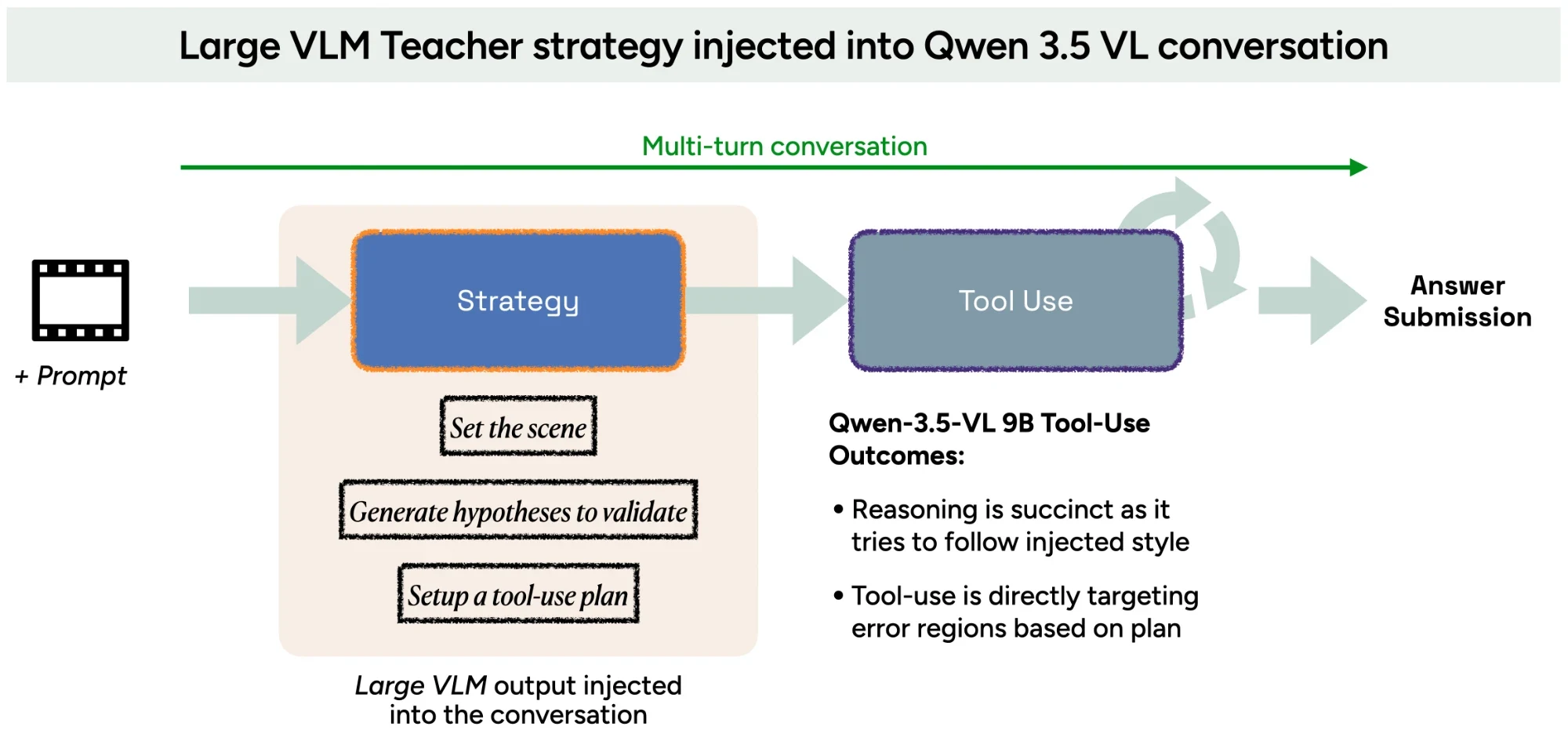
<p>Here’s something interesting I found: models like Qwen 3.5 VL 9B are absolutely capable of tool-use, but they are hampered by their inability to reason about the problem well, come up with hypotheses to test, and strategically use tools.</p>

<h2 id="research-question">Research Question</h2>

<p>If a bigger model, say Opus 5.5 or GPT-6 Sol, could provide the Qwen model with a strategy, can this strategy be injected into Qwen’s multi-turn conversation to improve tool use?</p>

<figure class="figure">
  <div class="frame"><img src="/assets/notes/strategy-injection/strategy-injection-01.webp" alt="Diagram titled “Large VLM Teacher strategy injected into Qwen 3.5 VL conversation”. A video and prompt lead into a Strategy step, produced by a large VLM and injected into the conversation, with three parts: set the scene, generate hypotheses to validate, and set up a tool-use plan. Strategy leads to a looping Tool Use step and then Answer Submission, along an arrow labelled multi-turn conversation. Listed Qwen-3.5-VL 9B tool-use outcomes: reasoning is succinct as it tries to follow the injected style, and tool use directly targets error regions based on the plan." loading="lazy" /></div>
</figure>

<p>The short answer is <strong>YES</strong>! In fact, it produced some rather interesting outcomes… not only did Qwen become more accurate at tool-use, but its reasoning traces on the video were shorter, more succinct and more confident. This side effect is interesting: by modifying the expectation of how the Qwen model should think about the video, it started adapting that thinking setting to all future turns.</p>]]></content><author><name>Aditya Chinchure</name><email>aditya10@cs.ubc.ca</email></author><category term="video" /><category term="vlms" /><category term="evaluation" /><category term="generative-ai" /><category term="tool-use" /><category term="agents" /><summary type="html"><![CDATA[Side note we worked on [[spotlight Spotlight]], a benchmark for local video generation error detection. Small VLMs are quite capable at tool use. I am working on a problem where we want to use tool-use agentic VLMs to study videos generated by T2V models, and identify errors in them. I provide the model with tools for viewing frames from videos at higher fps, showing frames side-by-side for comparisons, zooming into different frame regions, and even optical flow based frame motion comparison.]]></summary></entry><entry><title type="html">Testing the iPhone 18 Pro for photography</title><link href="https://www.adityachinchure.com/notes/iphone-18-pro-photos/" rel="alternate" type="text/html" title="Testing the iPhone 18 Pro for photography" /><published>2026-10-21T00:00:00-07:00</published><updated>2026-10-21T00:00:00-07:00</updated><id>https://www.adityachinchure.com/notes/iphone-18-pro-photos</id><content type="html" xml:base="https://www.adityachinchure.com/notes/iphone-18-pro-photos/"><![CDATA[<p>Here are some of my favourite photographs captured so far on the iPhone 18 Pro.</p>

<p>I find the photographic styles paired with the texture control to be really capable at making iPhone photos look unique and have richer, more contrasty colours. I find the grain to be too heavy-handed, and I’d like to see an update where we can control the amount of grain we want to add to the images.</p>

<p>The aperture control on iPhone 18 Pro is not useful in all situations, but I find myself reaching for it a lot when I am shooting pictures with a purpose… the f/4 gives you the sun stars, and the f/1.48 provides really nice background separation, especially when shooting at 2x zoom.</p>]]></content><author><name>Aditya Chinchure</name><email>aditya10@cs.ubc.ca</email></author><category term="photography" /><category term="iphone" /><summary type="html"><![CDATA[Here are some of my favourite photographs captured so far on the iPhone 18 Pro.]]></summary></entry><entry><title type="html">Spotlight: Identifying and Localizing Video Generation Errors Using VLMs</title><link href="https://www.adityachinchure.com/notes/spotlight/" rel="alternate" type="text/html" title="Spotlight: Identifying and Localizing Video Generation Errors Using VLMs" /><published>2025-11-01T00:00:00-07:00</published><updated>2025-11-01T00:00:00-07:00</updated><id>https://www.adityachinchure.com/notes/spotlight</id><content type="html" xml:base="https://www.adityachinchure.com/notes/spotlight/"><![CDATA[<p>As text-to-video models become more realistic, their errors are increasingly subtle, fine-grained, and localized in space and time. Spotlight evaluates whether current vision-language models can detect, localize, and explain these nuanced video-generation errors.</p>

<p>The benchmark contains 600 videos from state-of-the-art T2V models including Veo3, Seedance, and LTX-2, with over 1,600 expert annotations spanning physics, semantics, and anatomy.</p>

<figure class="figure">
  <div class="frame"><video class="clip" src="https://spotlight-video.github.io/assets/video/spotlight.mp4" poster="/assets/posts/spotlight/spotlight.png" aria-label="Spotlight project video. It opens on a generated video of a kangaroo with a joey in its pouch, with an annotated error showing the pouch looks like fabric rather than skin." muted="" loop="" playsinline="" controls="" preload="metadata"></video></div>
  <figcaption><span class="label">Fig. 01</span><span>Spotlight is a benchmark for evaluating whether VLMs can detect, localize, and explain fine-grained errors in high-fidelity text-to-video generations, with 600 videos and over 1,600 annotated error localizations.</span></figcaption>
</figure>

<p>Our experiments show that VLMs still lag far behind humans, with human performance nearly doubling the strongest baselines, highlighting the need for more robust perception and hallucination mitigation in automated video evaluation.</p>

<p><a href="https://arxiv.org/abs/2511.18102v1">arXiv</a> · Paper, code and dataset: <a href="https://spotlight-video.github.io">spotlight-video.github.io</a></p>

<section class="addendum">
  <p><span class="label">Addendum · 2026-06</span></p>

  <p>My paper Spotlight: Identifying and Localizing Video Generation Errors Using VLMs is accepted at ECCV 2026!</p>
</section>]]></content><author><name>Aditya Chinchure</name><email>aditya10@cs.ubc.ca</email></author><category term="video" /><category term="evaluation" /><category term="vlms" /><category term="generative-ai" /><summary type="html"><![CDATA[As text-to-video models become more realistic, their errors are increasingly subtle, fine-grained, and localized in space and time. Spotlight evaluates whether current vision-language models can detect, localize, and explain these nuanced video-generation errors.]]></summary></entry><entry><title type="html">SPIKE-RL: Video-LLMs meet Bayesian Surprise</title><link href="https://www.adityachinchure.com/notes/spike-rl/" rel="alternate" type="text/html" title="SPIKE-RL: Video-LLMs meet Bayesian Surprise" /><published>2025-09-01T00:00:00-07:00</published><updated>2025-09-01T00:00:00-07:00</updated><id>https://www.adityachinchure.com/notes/spike-rl</id><content type="html" xml:base="https://www.adityachinchure.com/notes/spike-rl/"><![CDATA[<p>Real-world videos often contain routine activity punctuated by surprising moments, but standard Video-LLM inference commonly samples frames uniformly and can miss the moments that define a video’s narrative.</p>

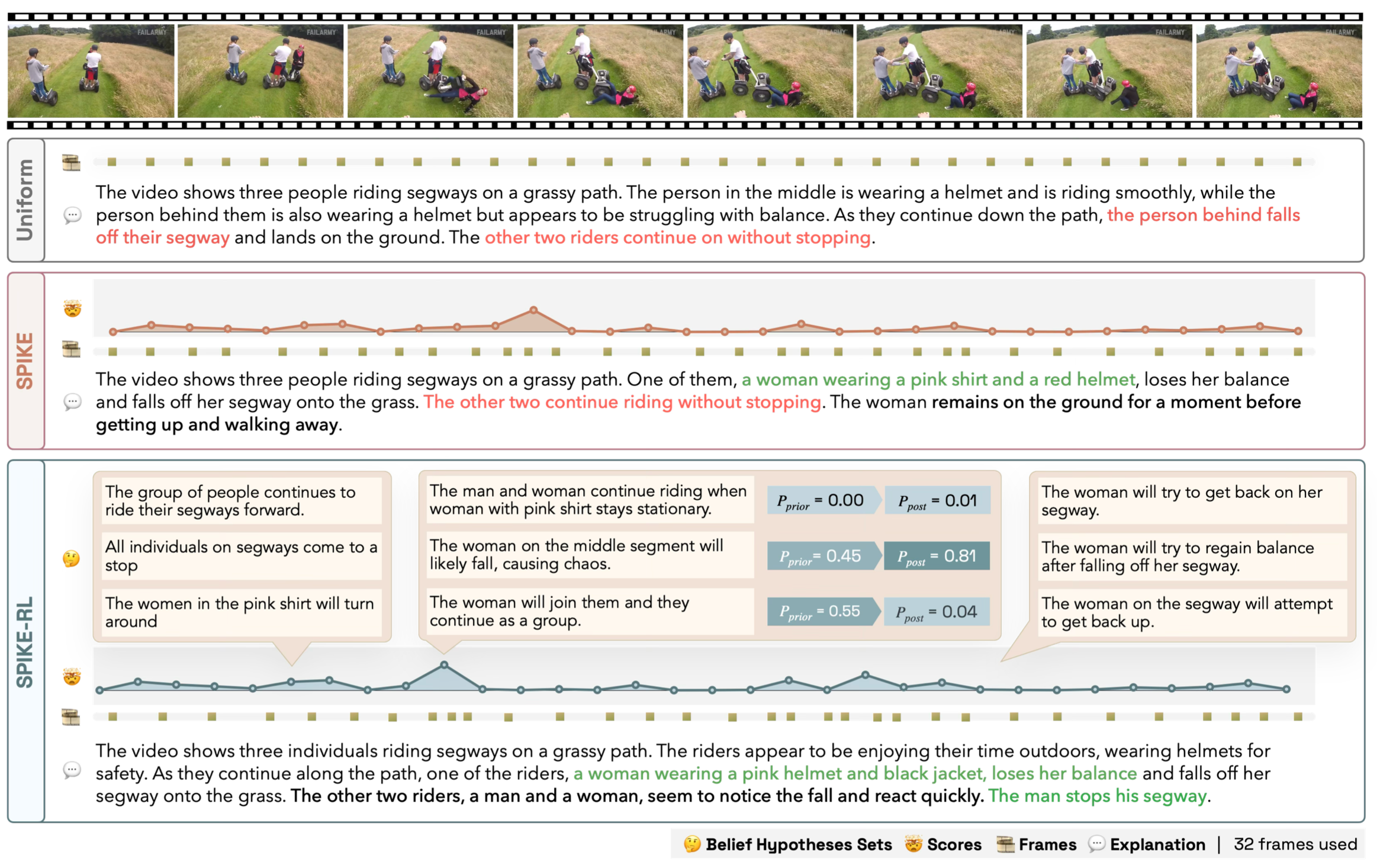
<p>SPIKE is an inference-time framework that measures Bayesian Surprise as the belief update triggered by new visual evidence, identifying when incoming frames conflict with prior beliefs. SPIKE-RL further improves these belief hypotheses with GRPO using rewards from video captions.</p>

<figure class="figure">
  <div class="frame"><img src="/assets/posts/spikerl/spikerl.png" alt="Eight frames of three people riding segways on a grassy path, comparing uniform frame sampling, SPIKE and SPIKE-RL. Each row shows the frames each method sampled, its surprise scores over time, belief hypotheses with prior and posterior probabilities, and its description of the video." loading="lazy" /></div>
</figure>

<p>Together, SPIKE and SPIKE-RL enable query-agnostic, surprise-weighted frame sampling that allocates more visual context to important moments, improving performance across five downstream video benchmarks.</p>

<p><a href="https://www.arxiv.org/abs/2509.23433">arXiv</a></p>

<section class="addendum">
  <p><span class="label">Addendum · 2026-04</span></p>

  <p>Attending ICLR 2026 in Rio de Janeiro, Brazil, to present SPIKE-RL.</p>
</section>]]></content><author><name>Aditya Chinchure</name><email>aditya10@cs.ubc.ca</email></author><category term="video" /><category term="surprise" /><category term="video-llms" /><category term="reinforcement-learning" /><summary type="html"><![CDATA[Real-world videos often contain routine activity punctuated by surprising moments, but standard Video-LLM inference commonly samples frames uniformly and can miss the moments that define a video’s narrative.]]></summary></entry><entry><title type="html">Black Swan: Abductive and Defeasible Video Reasoning in Unpredictable Events</title><link href="https://www.adityachinchure.com/notes/black-swan/" rel="alternate" type="text/html" title="Black Swan: Abductive and Defeasible Video Reasoning in Unpredictable Events" /><published>2024-12-01T00:00:00-08:00</published><updated>2024-12-01T00:00:00-08:00</updated><id>https://www.adityachinchure.com/notes/black-swan</id><content type="html" xml:base="https://www.adityachinchure.com/notes/black-swan/"><![CDATA[<p>The commonsense reasoning capabilities of vision-language models (VLMs), especially in abductive reasoning and defeasible reasoning, remain poorly understood. Most benchmarks focus on typical visual scenarios, making it difficult to discern whether model performance stems from keen perception and reasoning skills, or reliance on pure statistical recall. We argue that by focusing on atypical events in videos, clearer insights can be gained on the core capabilities of VLMs.</p>

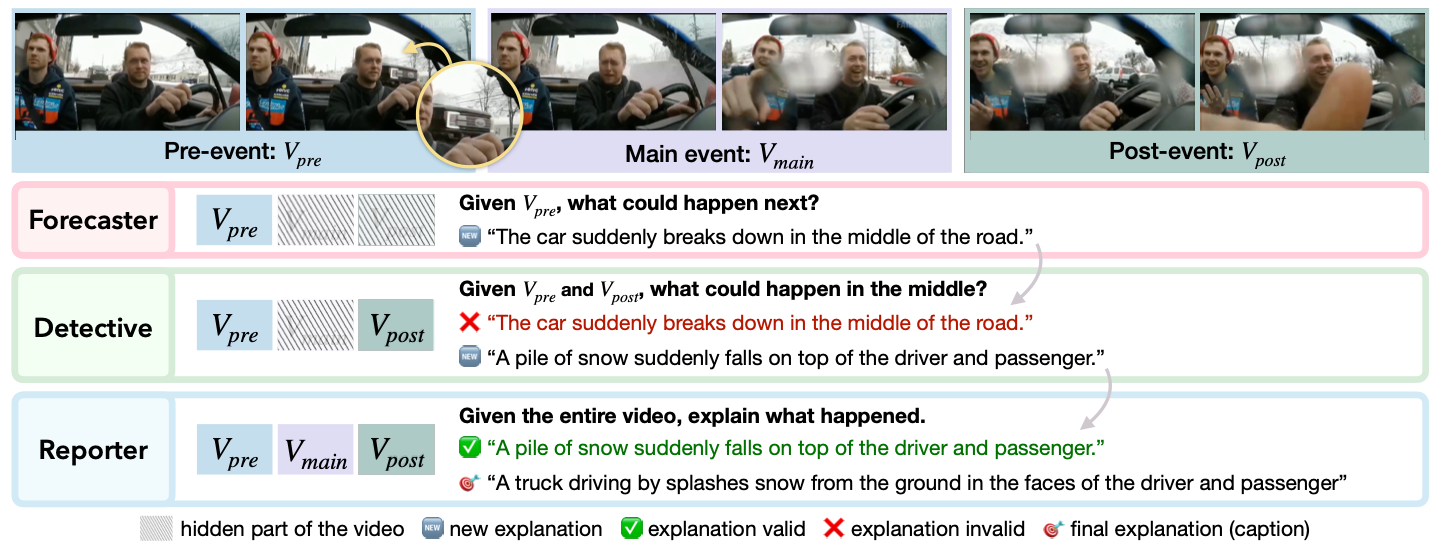
<p>Explaining and understanding such out-of-distribution events requires models to extend beyond basic pattern recognition and regurgitation of their prior knowledge. To this end, we introduce BlackSwanSuite, a benchmark for evaluating VLMs’ ability to reason about unexpected events through abductive and defeasible tasks. Our tasks artificially limit the amount of visual information provided to models while questioning them about hidden unexpected events, or provide new visual information that could change an existing hypothesis about the event.</p>

<figure class="figure">
  <div class="frame"><img src="/assets/posts/black-swan/black-swan.png" alt="Diagram of the Black Swan tasks on a dashcam video split into pre-event, main event and post-event parts. The Forecaster sees only the pre-event, the Detective sees the pre- and post-event, and the Reporter sees the whole video and explains what happened." loading="lazy" /></div>
</figure>

<p>We curate a comprehensive benchmark suite comprising over 3,800 MCQ, 4,900 generative and 6,700 yes/no tasks, spanning 1,655 videos. After extensively evaluating various state-of-the-art VLMs, including GPT-4o and Gemini 1.5 Pro, as well as open-source VLMs such as LLaVA-Video, we find significant performance gaps of up to 32% from humans on these tasks. Our findings reveal key limitations in current VLMs, emphasizing the need for enhanced model architectures and training strategies.</p>

<p><a href="https://arxiv.org/abs/2412.05725">arXiv</a> · <a href="https://blackswan.cs.ubc.ca">Website</a></p>

<section class="addendum">
  <p><span class="label">Addendum · 2025-02</span></p>

  <p>Our paper Black Swan: Abductive and Defeasible Video Reasoning in Unpredictable Events is accepted at CVPR 2025!</p>
</section>]]></content><author><name>Aditya Chinchure</name><email>aditya10@cs.ubc.ca</email></author><category term="video" /><category term="reasoning" /><category term="vlms" /><category term="benchmarks" /><summary type="html"><![CDATA[The commonsense reasoning capabilities of vision-language models (VLMs), especially in abductive reasoning and defeasible reasoning, remain poorly understood. Most benchmarks focus on typical visual scenarios, making it difficult to discern whether model performance stems from keen perception and reasoning skills, or reliance on pure statistical recall. We argue that by focusing on atypical events in videos, clearer insights can be gained on the core capabilities of VLMs.]]></summary></entry></feed>